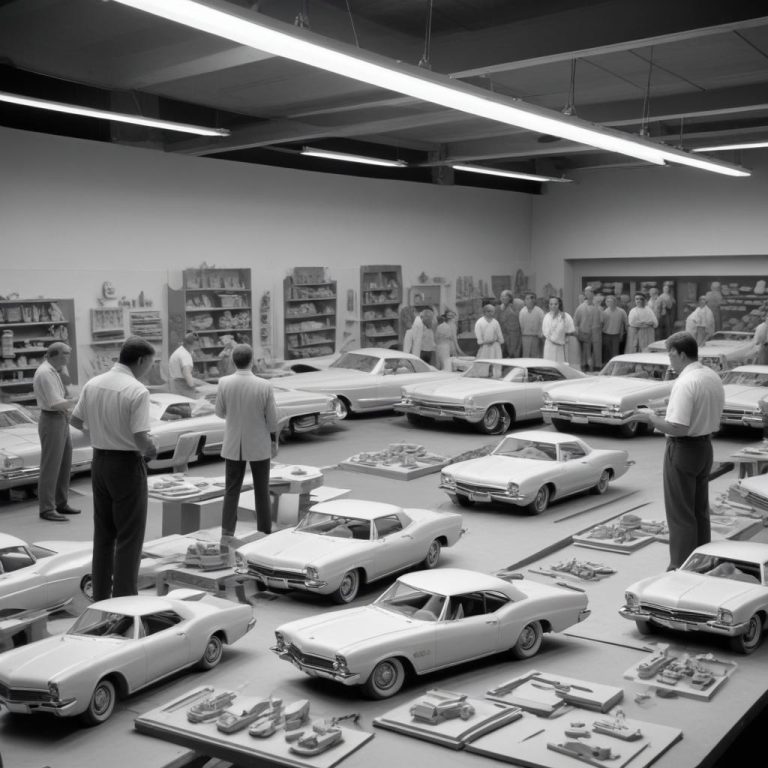
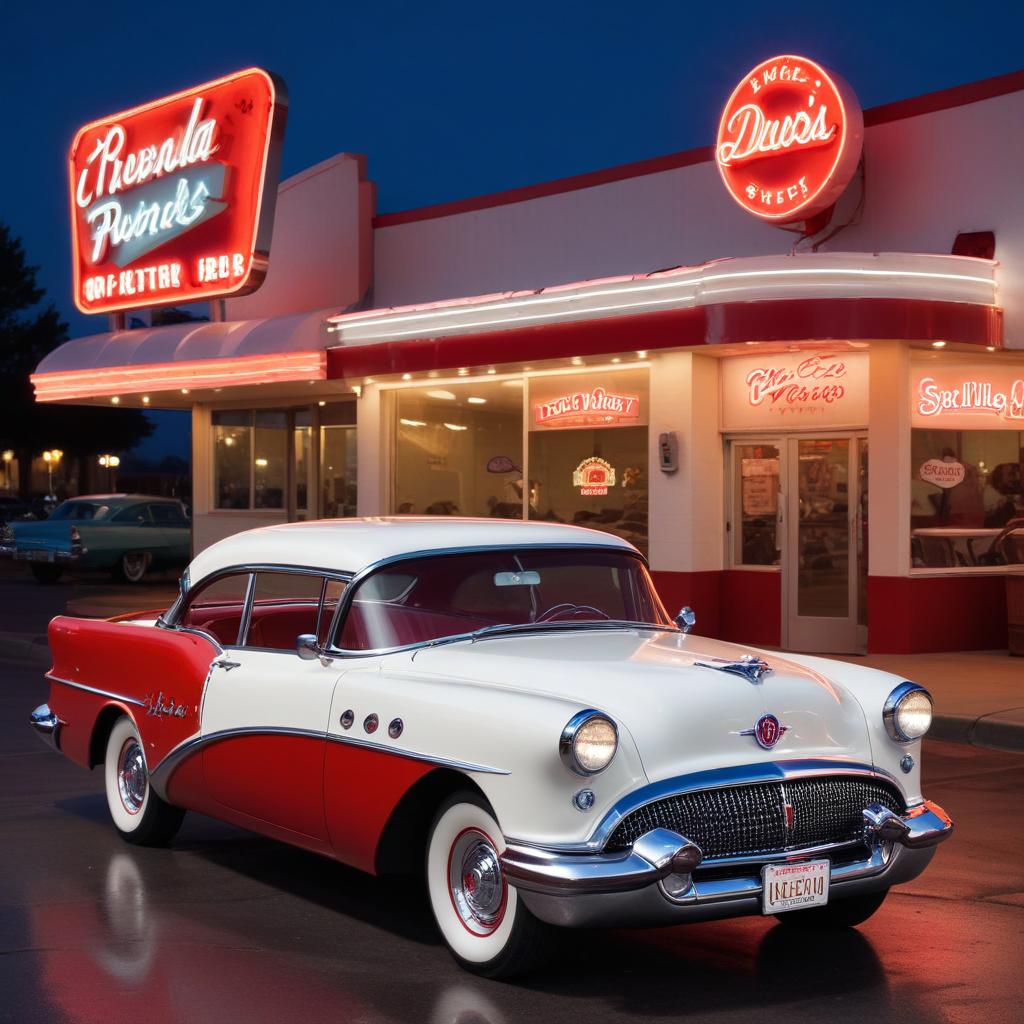
The 1955 Buick Century: The Original ‘Hot Rod’ Buick
You are standing at the corner of Woodward Avenue in 1955, and a flash of chrome and two-tone paint thunders past—it is not a Chevrolet, not a Ford, and definitely not some stripped-down hot rod; it is a Buick Century wearing a tailored suit, and it just hit 60 mph faster than a Chrysler 300, proving that the banker could absolutely outrun the kid.
TL;DR
The 1955 Buick Century is the forgotten father of the American muscle car. Six years before the Pontiac GTO, twelve years before the first Mustang GT, Buick was quietly—or rather, loudly—stuffing its biggest V8 into its lightest body and calling it a Century. With 236 horsepower from the legendary 322 cubic inch “Nailhead” V8, a sub-10-second sprint to 60 mph, and a top speed that genuinely earned its name, the ’55 Century was the original “banker’s hot rod.” It paced the Indianapolis 500. It chased speeders for the California Highway Patrol. It sold nearly 740,000 Buicks in a single year—a record the company never broke again. And today? A good one costs less than a new Nissan Versa. Here is why the 1955 Buick Century remains the most important Buick you have never considered.
Key Takeaways
- The Recipe: Take the lighter, nimbler body of the Buick Special. Add the 322 cubic inch “Nailhead” V8 from the Roadmaster. Result: 236 horsepower, 0–60 in 9.8 seconds, quarter-mile in 17.5 seconds—genuinely quick for 1955 .
- Nailhead Know-How: The engine earned its nickname from the tiny, vertically oriented valves that looked like nails. Hot rodders hated working on them. Drivers loved driving them .
- The Indy 500 Connection: The ’55 Century was the official pace car for the Indianapolis 500. It never actually paced the race—a mechanical issue sidelined it—but the association stuck .
- Cop Car Credentials: Buick built 268 specially equipped Centuries for the California Highway Patrol. Half had three-speed manuals. They were the fastest cop cars in America .
- Production Peak: Buick built 738,814 vehicles in 1955—third place industry-wide. The Century alone accounted for over 80,000 two-door hardtops. Buick has never sold that many cars in a single year since .
- Collector Math: Auction values average $37,775 as of late 2025, with pristine examples touching $43,000. That is 95% above the broader Century market average. These cars are rising .
The Recipe That Changed Everything
Let me explain why 1955 was the year Buick accidentally invented the muscle car.
The formula was simple: take the smaller, 4,300-pound body of the entry-level Buick Special—which was still enormous by modern standards, but light by 1950s luxury car metrics—and drop in the 322 cubic inch V8 from the flagship Roadmaster . The result was a car that weighed less, handled better, and accelerated harder than anything else in the Buick showroom.
This is where Buick’s engineering confidence peaked.
The Century name itself was a boast. It dated back to 1936, when Buick first achieved 100 mph by putting a big straight-eight into a small coupe. British motorists called hitting the century mark “doing the century.” Buick borrowed the term and never gave it back .
After World War II, the Century disappeared. Buick focused on floaty luxury. Cadillac and Oldsmobile launched modern overhead-valve V8s in 1949. Buick stuck with its antique straight-eight until 1953, when it finally—finally—unveiled the Nailhead .
The 1954 Century was the warm-up. The 1955 Century was the knockout.
For 1955, Buick raised compression to 9.0:1, added a hotter camshaft, and bolted on a four-barrel carburetor. Horsepower jumped from 200 to 236. Torque landed at 330 lb-ft . Zero to sixty dropped from the high 11-second range to 9.8 seconds—a tick quicker than the legendary Chrysler 300, although the Hemi would outrun the Buick on top end .
Car and Driver did not exist yet. But if they had, they would have been furious they missed this.
The Nailhead: Weird, Wonderful, and Wicked Fast
Here is the thing about the Nailhead. It was strange.
Most V8 engines of the era used large-diameter valves canted at angles to fit inside the combustion chamber. Buick went the opposite direction. The valves were tiny, stood almost perfectly vertical, and looked like—you guessed it—nails hammered into the block .
Hot rodders hated this. You could not easily port the heads. You could not install massive valves without machining new seats. The breathing was inherently restricted at high RPM.
But here is the secret nobody tells you.
The Nailhead did not need to breathe at 6,000 rpm. It made its power down low—mountains of torque—and delivered it with a deep, guttural rumble that sounded nothing like a Chevrolet small-block. It was a truck engine in a tuxedo. It pulled from idle like a freight train and never complained about regular gasoline .
The 1955 iteration was the first truly great Nailhead. It would evolve into 364 and 401 cubic inch versions that powered Buicks into the 1960s. But the 322 remains the one that put Buick back on the performance map.
And yes, it used a 12-volt electrical system by 1955. Buick was ahead of Ford on that one .
Dynaflow: The Smooth Operator
Let us address the transmission situation.
The 1955 Buick Century came standard with the Dynaflow automatic. It was a two-speed. It was heavy. It robbed measurable horsepower. And it was absolutely, completely, undeniably smooth .
Dynaflow was not a conventional automatic. It used a torque converter with variable-pitch stator blades. When you floored the throttle, the blades would cock open, multiplying torque and providing a more aggressive launch. Above 40 mph, a planetary gear set would engage, and the car would simply… glide .
Was it fast? Not by modern standards. The 0–60 time of 9.8 seconds was achieved with this transmission, which means the Century was fighting its own gearbox every shift .
Was it lovely? Absolutely. There is no lurch, no clunk, no hunting for gears. Just a seamless, endless wave of torque that pushes you deeper into that bench seat.
The California Highway Patrol thought it was good enough. They ordered 268 of them .
Chart: 1955 Buick Century Performance vs. Rivals
This chart illustrates where the Century sat in the 1955 pecking order—not the king of top speed, but the king of the stoplight.
Data sources: Autoweek road test, Standard Catalog of American Cars, period road tests . Note: Chrysler C-300 used a 300-hp Hemi and three-speed manual; its top speed advantage was substantial.
Styling That Sold Itself
Let us be honest about something else.
The 1955 Buick Century did not look like a hot rod. It looked like a bank president’s weekend car—which was precisely the point.
The face: A delicate mesh grille that replaced the toothy chrome bars of earlier Buicks. Cleaner. More sophisticated. Less “smiling clown,” more “smiling executive” .
The sides: Sweeping character lines that ran from the front wheel arches to the tail. And those VentiPorts—three portholes on each front fender, a Buick signature since 1949, supposedly indicating the number of cylinders. (VentiPorts appeared on V8 cars. Nobody asked why a V8 needed three holes on each side. They just looked cool.) .
The tail: Small, round taillights integrated into modest fins. Not the jet-age rocketships Cadillac was building. Just enough drama to let you know this car meant business .
The Riviera hardtop: This was the look. Pillarless side windows. No center post. When you rolled all four windows down, the cabin became an open-air experience without the canvas roof. The 1955 Century Riviera coupe accounted for 80,338 units—the most popular body style by far .
One owner of a ’55 Riviera wrote: “Many people assume it’s a custom-bodied car from the side. They cannot believe it left the factory looking this good.” .
Inside the Banker’s Office
Open the door. Sit down.
That is not a car seat. That is furniture.
The 1955 Century interior was designed for people who wore hats. The seat height was chair-high—none of this “fall into the bucket” nonsense. You sat up. You surveyed the road like a ship captain .
The dashboard: Pressed steel with engine-turned trim panels. Dual round gauge pods directly in front of the driver. A cluster of black-knobbed levers on the left that controlled headlights, dash lights, and wipers. A steering wheel so large and thin-rimmed it felt like you were guiding a yacht—because, in many ways, you were .
The options: Power windows (complicated, heavy, and fabulous). Power seats. Power brakes. Power steering. A Selectronic push-button radio with an electric antenna. A clock that probably did not keep perfect time but looked magnificent trying .
The seating: Bench front, bench rear. Six adults, no complaints. The upholstery was available in genuine leather or high-grade broadcloth. Two-tone interiors matched the two-tone paint. Red and gray. Blue and white. Green and beige .
This is where Buick’s comfort engineering peaked in the 1950s. You did not drive a Century. You were driven in it—even when you were the one steering.
The California Highway Patrol Connection
Here is a detail that surprises almost everyone.
Buick built 268 specially equipped Century two-door sedans for the California Highway Patrol in 1955 .
These were not off-the-shelf Riviera hardtops. They were based on the Buick Special two-door sedan body—a lighter, less ornate shell—but from the firewall forward, they were pure Century. That meant the 322 Nailhead, the heavy-duty cooling system, and upgraded suspension components.
And about half of them had three-speed manual transmissions .
Think about that. A manual Buick. A police pursuit Buick. A car designed to run 120 mph all day on California highways, chasing down everything from hopped-up Fords to fleeing Cadillacs.
The CHP Centuries are almost impossible to find today. Most were driven hard, crashed, or simply worn out. But their existence proves that Buick understood performance buyers—even if those buyers wore badges.
Timeline: The Century’s 1955 Peak
Comparison Table: 1955 Buick Century Body Styles
| Body Style | Production | Key Features | Collector Appeal | Notable Details |
|---|---|---|---|---|
| Riviera Hardtop Coupe | 80,338 | Pillarless design, two-door, B-pillar delete | Highest | The definitive ’55 Century look. Most sought-after today . |
| Convertible | Unknown, rare | Power top, Skylark wire wheels optional | Very high | Open-air banker’s hot rod. Currently commanding strong auction interest . |
| 4-Door Sedan | High volume | Most practical, six-passenger seating | Moderate | Affordable entry point to Century ownership . |
| Station Wagon | Low | Woodgrain trim, massive cargo capacity | Rising | Rarest body style. Cult following emerging . |
| CHP Special | 268 | Two-door sedan body, manual transmission option | Extreme | Nearly impossible to find. Holy grail for police car collectors . |
The Driving Experience: What It Actually Feels Like
I need to be honest with you.
Driving a 1955 Buick Century in 2026 is not like driving a modern muscle car. It is not even like driving a 1960s muscle car. It is a distinct, peculiar, utterly addictive experience that has almost nothing to do with speed.
Startup: The Nailhead fires with a bark, then settles into a lumpy idle. You smell gasoline. You feel the steering wheel vibrate slightly. The Dynaflow takes a moment to build pressure .
Acceleration: You press the throttle. The car does not lunge. It surges. There is a delay—the converter is multiplying torque, the stator blades are cocking open—and then, without drama, 4,300 pounds of steel and chrome begins to move. Forty miles per hour arrives silently. Seventy arrives before you expect it .
Braking: This is the weak link. Drum brakes all around. No power assist from the factory (though many cars were retrofitted). You plan your stops. You leave distance. You learn to drive ahead of the car, not with it .
Cornering: The Century floats. Coil springs at all four corners, soft bushings, bias-ply tires that squirm under load. The steering is numb and over-assisted. You do not carve canyons in a 1955 Buick. You cruise boulevards .
And yet.
There is a magic here that no spec sheet captures. The way the light reflects off that massive chrome grille. The sound of the door closing—solid, bank-vault, unmistakably American. The way people stare, point, and smile when you roll past.
You are not driving a car. You are driving a moment in history that happens to have wheels.
Collector Market: The Numbers Don’t Lie
Let us talk money.
As of late 2025, the average auction price for a 1955 Buick Century is $37,775 . That is based on documented sales in the last 12 months. Values range from $32,550 to $43,000, with exceptional examples—rare body styles, documented provenance, numbers-matching components—crossing into five figures .
Compare that to:
- 1955 Ford Thunderbird: $55,000–$75,000
- 1955 Chrysler C-300: $70,000–$120,000
- 1955 Chevrolet Bel Air: $40,000–$90,000
The Century offers genuine performance heritage at a discount. It is not as recognized as the T-Bird. It is not as celebrated as the Bel Air. But it is rarer, faster, and—dare I say—more interesting than both.
Private party values: Good condition examples trade between $16,000 and $25,000 . Project cars with rust and mechanical needs sell for under $10,000 . The 1955 Century is not yet priced into the stratosphere. That window is closing, but it is not shut.
One expert note: The 1955 model commands a 95% premium over the overall Buick Century market average. Collectors know that 1955 was the peak .
What to Look For: Buyer’s Advice
If you are shopping for a 1955 Buick Century, here is what matters.
Rust. These cars unibody? No—they are body-on-frame. But the floors, trunk pans, and lower quarters rust badly. A car that lived in the Northeast or Midwest likely needs metalwork. California, Southwest, and Northwest cars are cleaner .
Drivetrain. The Nailhead is durable but parts availability is uneven. Engine internals are rebuildable. Water pumps, fuel pumps, and gasket sets are available. The Dynaflow transmission is robust if maintained; slipping usually means low fluid or worn seals .
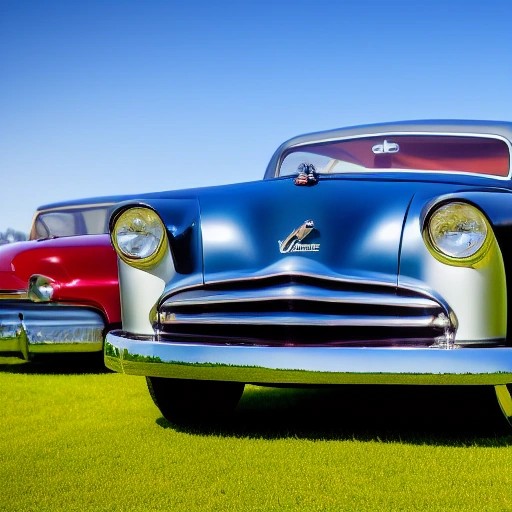
Authenticity. Paint color matters to collectors. The 1955 palette included Cadet Blue, Cascade Blue, Colonial Blue, Stafford Blue, and a dozen other shades. This car in the photos is a beautiful blue—but it is not a factory 1955 Buick blue. Does that matter? Only if you care about judged shows .
Documentation. Provenance adds value. The 1955 Century once owned by Philip D. Armour III (heir to the meat-packing fortune) sold for strong money because the story was documented .
Options. Power windows are cool. Power seats are rarer. Factory air conditioning is extremely rare and valuable. The Selectronic radio with electric antenna is a nice touch. Wire wheels—especially the Skylark wheels—transform the car visually .
Frequently Asked Questions
Why is it called “Century”?
The name dates to 1936, when Buick achieved 100 mph in a production car. British motorists called hitting 100 mph “doing the century.” The name returned in 1954 with the same big-engine, light-body formula .
How fast is a 1955 Buick Century?
0–60 in 9.8 seconds. Quarter-mile in 17.5 seconds. Top speed approximately 110 mph. In 1955, that was genuinely quick .
What is a “Nailhead” V8?
Buick’s first overhead-valve V8, introduced in 1953. Nicknamed for the tiny, vertically oriented valves that resembled nails. The 1955 version displaced 322 cubic inches and produced 236 horsepower .
Is the 1955 Buick Century reliable?
As a daily driver? No. As a weekend classic with regular maintenance? Surprisingly yes. The mechanical systems are simple and well-understood. Parts availability is good for most components .
What is a Century worth today?
Auction average: $37,775. Private party range: $16,000–$25,000 for driver-quality cars. Project cars under $10,000. Concours examples exceed $50,000 .
Did the Century really pace the Indy 500?
It was selected as the official pace car. Reports indicate mechanical issues prevented it from actually pacing the field. The designation still appears in period advertising and remains part of the car’s legacy .
How many 1955 Buick Centuries were built?
Over 80,000 Riviera hardtop coupes alone. Total production across all body styles exceeded 100,000. It was not rare then; it is increasingly rare now .
What should I look for when buying one?
Rust in floors and lower quarters. Original engine and transmission numbers. Documentation and provenance. Avoid poorly executed modifications. The Nailhead is finicky about carburetion and ignition; modified cars can be headaches .
The Verdict: The Original Hot Rod That History Forgot
Here is what I need you to understand.
The 1955 Buick Century was not the most powerful car of its era. The Chrysler 300 had 300 horsepower. The fuel-injected Corvette was coming. The Thunderbird was prettier.
But the Century was the first car that proved performance and luxury could share a garage.
It was not a stripped-down racer. It had power windows. It had a clock. It had upholstery that would not embarrass you at the country club. And yet, with 236 horsepower and a 9.8-second 0–60 time, it would absolutely humiliate anything wearing a Cadillac or Lincoln badge.
That is the “banker’s hot rod” promise. You do not need to sacrifice comfort for speed. You do not need to choose between style and performance. You can have both.
Buick sold 738,814 cars in 1955. They have never sold that many in a single year since. The Century was not the only reason—the whole lineup was stellar—but it was the halo. It was the car that made people walk into Buick showrooms and say, “I want that one.”
Seventy years later, the 1955 Century remains the definitive expression of Buick’s original performance philosophy. It is elegant. It is fast. It is comfortable. It is important.
And you can still buy one for less than a used Honda Civic.
That will not last forever. The market is waking up. The boat-tail Rivieras are already expensive. The first-generation Skylarks are six figures. The 1955 Century is the last great Buick performance car that remains reasonably priced.
Do not wait until the bankers discover it again.
Did your family own a 1955 Buick Century? Have you restored one? Spotted a CHP car at a show? Drop your story in the comments—these cars deserve to be remembered, and your memory might be the one that inspires someone else to save one.
References:
- Barn Finds: Rebuilt Engine And More: 1955 Buick Century (2025)
- Metro Moulded Parts: 1955 Buick Century Catalog and Classic Car Guide
- Barn Finds: Buick’s Factory Hot Rod: 1955 Century Convertible with No Reserve (2024)
- Classic Driver: 1955 Buick Century Convertible – French Market Example
- Autoweek: 1955 Buick Century Convertible: Buick’s Second Century (2004)
- Carsales: 1955 Buick Century Specifications
- Classic Driver: 1955 Buick Century Riviera – UK Market Example
- ClassicCars.com Journal: Pick of the Day – 1955 Buick Century (2017)
- Carsales: 1955 Buick Century Pricing & Specifications
- Old Cars Data: 1955 Buick Century Auction Values (2025)